
If you’ve been curious about Brazilian Jiu-Jitsu but have no idea where to start, you’re in the right place. BJJ for beginnerscan feel daunting at first — a new language of positions, a room full of people in strange pyjamas, and the very real prospect of being put on the floor repeatedly. But here’s the truth: every single person on that mat was once exactly where you are now. And most of them will tell you that starting BJJ was one of the best decisions of their lives.
In this complete guide, we’ll walk you through everything a newcomer needs to know — what BJJ actually is, what to expect in your first class, the belt system, essential beginner techniques, and how to find a great gym near you.
Brazilian Jiu-Jitsu uses leverage and technique over brute strength, making it accessible to people of all sizes and fitness levels.
What Is Brazilian Jiu-Jitsu?
Brazilian Jiu-Jitsu is a grappling-based martial art that focuses primarily on ground fighting and submission holds. Unlike striking arts such as boxing or Muay Thai, BJJ practitioners aim to control their opponent through positional dominance and force a submission via joint locks or chokes — without ever throwing a single punch.
BJJ traces its roots to Japanese Judo, which was brought to Brazil in the early twentieth century by Mitsuyo Maeda. The Gracie family refined and adapted the art over decades, developing a system that allows a smaller, weaker person to defend against and defeat a larger, stronger attacker. That core principle — leverage over strength — is what makes BJJ so uniquely empowering.
Today, BJJ is practised by millions worldwide. It forms the backbone of most competitive MMA fighters’ skill sets and is equally popular as a standalone sport, a fitness pursuit, and a practical self-defence system. According to industry statistics, the global martial arts market reached $21 billion in 2026, with BJJ among the fastest-growing disciplines.
What to Expect in Your First BJJ Class
Walking through the door of a BJJ gym for the first time is a memorable experience. Here’s what a typical beginner class looks like so you know exactly what you’re getting into.
The Warm-Up
Classes usually begin with a general warm-up — jogging, jumping jacks, and dynamic stretching — followed by BJJ-specific movements like forward and backward rolls, shrimping (a hip escape drill essential to escaping bad positions), and break-falls. Don’t worry if these feel awkward at first; they become second nature very quickly.
Technique Drilling
The instructor will demonstrate one or two techniques, then pair you up with a partner to drill them repeatedly. Drilling is the foundation of BJJ learning — you’re building muscle memory through repetition. As a beginner, focus on understanding the principle behind the move rather than executing it perfectly.
Rolling (Sparring)
The final portion of class is “rolling” — live sparring where you apply what you’ve learned against a resisting partner. Most instructors will introduce beginners to rolling gradually and pair you with experienced students who will guide rather than overpower you. Tap early, tap often. There is absolutely no shame in tapping out; it’s how you learn safely.
Understanding the BJJ Belt System
The Brazilian Jiu-Jitsu belt system is notably different from many other martial arts. Promotions are hard-earned and can take years — which is precisely why a BJJ black belt commands such deep respect in the martial arts world.
- White Belt — The beginning. Everyone starts here. Focus on learning the basics and surviving rolls.
- Blue Belt — Typically earned after 1–2 years of consistent training. You understand fundamental positions and submissions.
- Purple Belt — An intermediate rank. You’re starting to develop a personalised game and understanding of transitions.
- Brown Belt — An advanced practitioner with a deep technical understanding.
- Black Belt — The pinnacle of BJJ achievement, usually requiring 10 or more years of dedicated training.
Progress between belts is judged by your instructor and is based on technical skill, mat time, competition performance, and character — not by passing a fixed test. Patience is a virtue in BJJ.
Essential Techniques Every BJJ Beginner Should Learn
While BJJ has hundreds of techniques, a handful of fundamentals will serve as the bedrock of your entire game. Prioritise these in your early months:
1. The Guard Position
Guard is your most important defensive tool. When you’re on your back with your legs wrapped around your opponent, you are “in guard.” Far from being a weak position, a good guard is a powerful attacking platform. Learning to hold, sweep from, and submit from guard is arguably the most important skill for any beginner.
2. The Rear Naked Choke
The rear naked choke (RNC) is one of the most effective submissions in all of grappling. Applied from behind the opponent, it compresses the carotid arteries to cause a loss of consciousness within seconds if not tapped to. Learning this submission teaches you about control, positioning, and the mechanics of choking.
3. The Armbar
The armbar is a joint lock targeting the elbow. It can be applied from several positions — mount, guard, and side control among them. Understanding the armbar builds awareness of controlling limbs and exploiting positional advantages.
4. Shrimping and Hip Escapes
Shrimping is the fundamental movement used to escape bad positions and create space. If you only drilled one thing in your first six months, this would be it. Hip mobility and the ability to create frames are the building blocks of good BJJ defence.
5. Passing the Guard
When your opponent is in guard, your job is to “pass” — to move past their legs to a dominant position like side control or mount. Basic guard passes such as the toreando (bullfighter) pass and the knee cut give beginners reliable tools to advance their position.
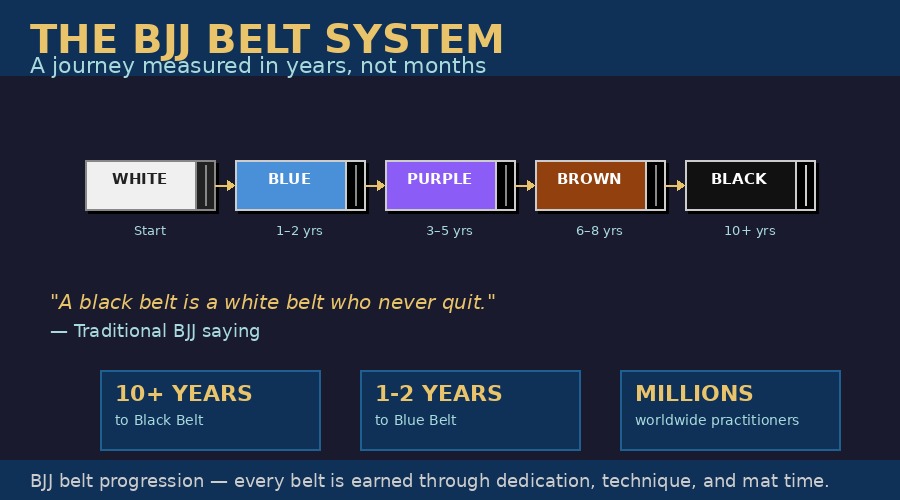
The BJJ belt system rewards dedication and technical mastery. Progress takes time, but every belt earned is deeply meaningful.
10 Practical Tips for BJJ Beginners
- Be consistent. Training twice a week beats one long session occasionally. Frequency builds retention.
- Tap early. Never let ego stop you from tapping. Injuries set you back weeks; tapping costs you nothing.
- Stay relaxed. Tension drains energy and telegraphs your movements. Breathe, and let technique do the work.
- Ask questions. Good instructors love curious students. Ask for clarification after class rather than during drilling.
- Watch instructional videos. Supplement your mat time with YouTube tutorials from trusted instructors like John Danaher, Gordon Ryan, or the Gracie Academy.
- Keep your nails trimmed. Long nails scratch training partners. This is non-negotiable in any gym.
- Wash your gi after every session. Hygiene on the mat is a shared responsibility.
- Don’t compare your progress. Everyone advances at a different pace. Focus on your own journey.
- Embrace the uncomfortable. Being put in bad positions is how you learn to escape them. Don’t avoid the discomfort.
- Commit to at least 10 classes. BJJ is notoriously hard to grasp in the first few sessions. Give it time before making a judgement.
| “A black belt is a white belt who never quit.” — Traditional BJJ saying |
What Do You Need to Get Started?
For your very first few classes, you need very little. Wear comfortable athletic clothes — a rash guard and board shorts work well — and many gyms will lend you a gi (the traditional BJJ jacket and trousers) for trial classes. Once you’re committed, investing in your own gi is worthwhile. A good beginner gi costs between £60 and £120 and will last years with proper care.
Other useful kit as you progress includes a mouthguard (especially if you plan to compete), a rash guard to wear under your gi, flip flops for walking on and off the mat, and a bag large enough to carry a sweaty gi home.
How to Find a Good BJJ Gym Near You
Not all gyms are equal. When visiting potential academies, look for the following:
- A qualified instructor with a legitimate BJJ lineage (black belt credentials you can verify)
- A welcoming atmosphere where beginners are respected and protected
- Clean mats — non-negotiable for hygiene and skin infection prevention
- A structured beginner programme rather than throwing you straight in with advanced students
- The opportunity to watch or trial a class before committing
Most reputable BJJ gyms offer a free trial class. Take advantage of this at multiple gyms if possible — the culture and community of the gym matters as much as the quality of instruction.
Ready to Start Your BJJ Journey?
Brazilian Jiu-Jitsu is one of the most rewarding martial arts you can pursue. It challenges your mind as much as your body, builds genuine functional fitness, and offers a community of training partners who will push and support you for years to come. Whether your goal is competition, self-defence, fitness, or simply finding something that gets you off the sofa and onto the mat — BJJ delivers.
The best time to start was yesterday. The second best time is today.